The Q3 Clock Is Getting Real for Tax-Motivated STR Buyers

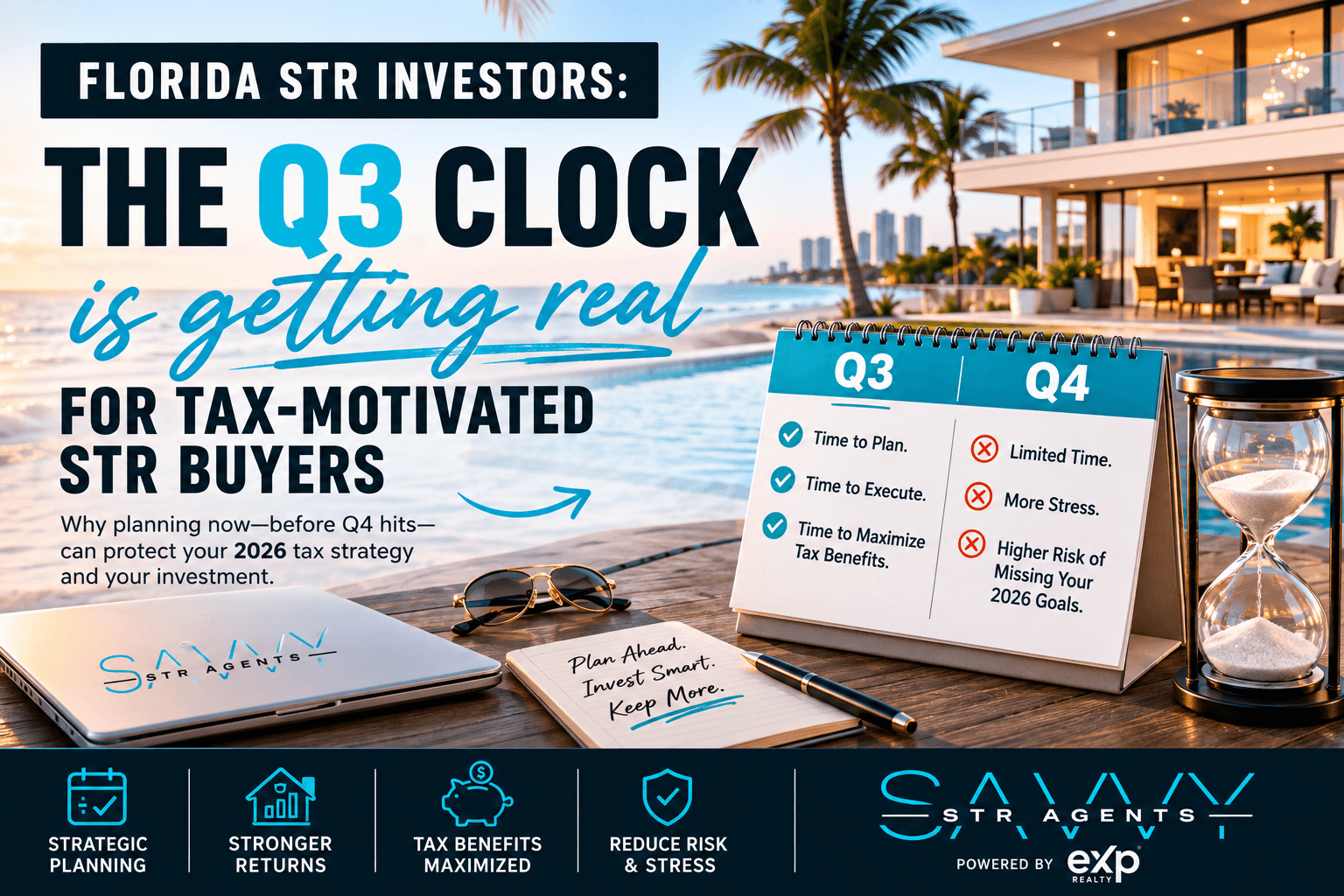
Buying a Short-Term Rental for Your 2026 Tax Strategy? The Clock Matters.
If purchasing a short-term rental is part of your 2026 tax strategy, Q3 may be one of the most important planning periods of the year.
Not because 100% bonus depreciation disappears at the end of 2026—it doesn't under current federal law. The real issue is much simpler:
Your 2026 calendar is running out.
For investors hoping to use a short-term rental as part of their 2026 tax strategy, purchasing the property is only one piece of the process. Depending on the property and your individual tax strategy, you may still need time to close, renovate, furnish, prepare the property for guests, coordinate a cost segregation study, and get the appropriate assets placed in service.
Why Q3 Is Different From Q4
An investor beginning the process in August or September has something extremely valuable: flexibility.
You have more time to:
- Find the right property instead of rushing into what's available
- Negotiate purchase price and seller concessions
- Complete inspections and financing
- Handle renovations or value-add improvements
- Furnish and professionally design the STR
- Complete photography and listing preparation
- Coordinate with your CPA and cost segregation professional
- Get the property ready for its intended rental use
Once we move deeper into Q4, every delay becomes more important.
An appraisal taking an extra week, a contractor falling behind, furniture arriving late, or a closing extension can suddenly affect the entire timeline.
What Does 100% Bonus Depreciation Actually Mean?
One misconception I see frequently online is that buying a $500,000 short-term rental automatically means receiving a $500,000 tax deduction.
That is not how it works.
Current federal law provides 100% bonus depreciation for eligible qualifying property. A cost segregation study can help identify components of a real estate investment that may qualify for shorter depreciation schedules and potentially bonus depreciation.
The actual tax benefit depends on the property, allocation of the purchase price, the investor's individual tax situation, participation requirements, and other tax rules.
That is why I encourage investors to involve their CPA or qualified tax professional before making an acquisition based primarily on tax benefits.
The Better Way to Buy a Tax-Motivated STR
Instead of starting with, "Show me some Airbnbs," I prefer to start with a different question:
"What did your CPA tell you you're trying to accomplish, and by when?"
Then we can reverse-engineer the acquisition.
Tax goal → deadline → property criteria → financing → acquisition → renovations → furnishing → launch.
This also helps determine what type of property makes sense.
An investor beginning in Q3 may have enough runway to purchase a property requiring meaningful value-add improvements.
An investor starting very late in Q4 may need to prioritize something much closer to being operational rather than taking on a major renovation.
Don't Buy a Property Just for the Tax Benefit
A tax benefit can make a strong investment better. It should not be the only reason a weak investment suddenly looks attractive.
I still want to evaluate the fundamentals:
- Purchase price
- Realistic STR revenue potential
- Operating expenses
- Property taxes
- Insurance
- Financing
- HOA costs and restrictions
- Local short-term rental regulations
- Renovation and furnishing costs
- Cash flow and return on investment
- Resale and appreciation potential
The goal is to find a property that makes sense as an investment first—and then work with the appropriate tax professionals to understand how available tax strategies may improve the overall return.
Thinking About Buying a Florida STR Before the End of 2026?
If your CPA has recommended purchasing a short-term rental or investment property this year, don't wait until December to begin figuring out the real estate side.
We can work backward from your timeline, identify Florida markets where short-term rentals are permitted, analyze potential revenue and expenses, and determine which properties have the strongest combination of cash flow, value-add potential, and execution timeline.
The tax opportunity may be permanent. Your 2026 calendar isn't.
Ready to start? Reach out and let's build your Florida STR acquisition strategy before Q4 turns into a race against the clock.
Disclaimer: This article is for educational and real estate informational purposes only and is not tax, accounting, or legal advice. Tax benefits, depreciation, material participation, cost segregation, and eligibility vary by taxpayer and property. Consult a qualified CPA or tax professional regarding your individual circumstances.

Written by Ana Estevez
Ana Estevez is a Florida real estate professional with five years of experience and more than 30 completed transactions, including eight short-term rental deals. Before specializing in STR investments, Ana built a strong foundation in residential sales, long-term rentals, off-market acquisitions, wholesale opportunities, distressed properties, and the title industry. This experience allows her to recognize potential problems early, structure stronger offers, and guide investors through the entire transaction—not simply help them find a property. With a bachelor’s degree in Business Administration and Accounting, Ana brings a numbers-first approach to real estate. She helps investors evaluate cash flow, revenue potential, renovation opportunities, operating expenses, appreciation, and tax-strategy considerations in coordination with their financial professionals. After entering the St. Augustine short-term rental market, Ana discovered the perfect intersection of everything she enjoyed most: real estate, investment analysis, hospitality, design, and helping families build long-term wealth. Today, through Savvy STR and eXp Realty, she specializes in helping investors identify and acquire short-term rental opportunities throughout Daytona Beach, South Daytona, Daytona Beach Shores, Port Orange, St. Augustine, and select Florida markets. Her service goes well beyond property showings. Ana assists with market and zoning research, revenue projections, comparable-property analysis, negotiation, due diligence, renovation and amenity planning, and vendor coordination. Whether an investor’s priority is cash flow, tax benefits, appreciation, or a combination of all three, Ana builds the strategy around the investor’s specific goals. Ana’s advantage is simple: she understands both the numbers behind the investment and the details required to get the transaction successfully to the closing table.
View Profile