Jersey Shore Short-Term Rental Rules, Town by Town: What Actually Kills a Deal

I keep a 26-town ordinance file because a Jersey Shore pro forma can be wrong before I enter a single revenue number.
New Jersey has state tax rules for transient rentals, but it does not give Shore investors one operating rulebook. Minimum stays, permits, inspections, zoning, and local taxes are largely municipal. Crossing a town line can change the rental strategy.
That fragmentation helps explain why the Jersey Shore remains an overlooked short-term rental market, and why I screen the town before the house.
Four questions I ask before revenue
1. What is the shortest legal stay?
Most buyers ask, “Are short-term rentals allowed?” That is too broad.
Bradley Beach, for example, requires a minimum rental of 6.5 days, or 156 hours. That removes the Friday-to-Sunday business, including much of the shoulder season.
Bradley Beach can still work. You just have to model it as a weekly market. By contrast, I did not find a stated minimum in the Belmar, Surf City, or Long Beach Township codes when I reviewed them.
2. Does this specific address qualify?
A town-wide “yes” is not an address-level “yes.” The zoning district, property type, ownership structure, master deed, and HOA rules can all matter. Upper Township, for example, ties its rules to zoning and parcel characteristics. A condominium can clear the town rule and still be barred by its own documents.
Owner occupancy belongs in this check too. Never carry that assumption from one town or property class to the next.
3. How often does this town inspect, and can it be done remotely?
This is the question I almost never hear a buyer ask, and it is the one that shows up in your operating costs every single season.
The spread is enormous. Sea Isle City’s code inspects each dwelling unit at least once every ten years. Bradley Beach’s code goes the other way: Chapter 160 directs the Code Official to reinspect a rental unit on transfer of ownership and on a change in tenant. Upper Township’s general rental ordinance reads similarly, requiring inspection prior to every change of tenancy and every year.
Read that against a rental calendar. An inspection tied to turnover is a different business than an inspection tied to a license year.
Between those poles sits almost everything else. Avalon and Wildwood Crest inspect once per license year. Cape May City and Middle Township inspect annually, and Middle Township is pass or fail with no conditional licenses. Beach Haven splits it, inspecting seasonal rentals once a year before May 31 while long-term rentals get inspected at each tenant change.
Then ask who has to be there. Wildwood requires sign-off from the Construction Official, the Property Inspector, the Chief of Police, and the Fire Official. Lower Township requires four sign-offs of its own, including the Tax Collector. Those are calendar problems, not fee problems.
Whether a town accepts a self-certification or demands an in-person visit is worth a direct question to the clerk, because it is the kind of practice that changes without the code changing. Ocean City is the one I always confirm by phone.
4. Which taxes actually apply to this booking?
“The tax is 11.625%” is incomplete, and the incomplete version is expensive.
That figure is New Jersey’s 6.625% sales tax plus the 5% state occupancy fee, and it generally applies to bookings made through an online marketplace like Airbnb or Vrbo. A municipality may add up to 3% on top, and Cape May County layers on a 2% tourism tax and a 1.85% tourism assessment. In the Wildwoods the state occupancy fee drops to 3.15%, but the county layers push the all-in stack there past 15%, the heaviest on the Shore.
The channel matters as much as the town. Under state guidance, a rental executed by a licensed New Jersey real estate broker, where keys are handed over at the broker’s office, is not subject to these taxes and fees at all. A booking taken directly from the owner, outside any marketplace, is treated differently again, and stops being exempt once the owner offers three or more units for rent in New Jersey. That threshold catches more growing portfolios than people expect.
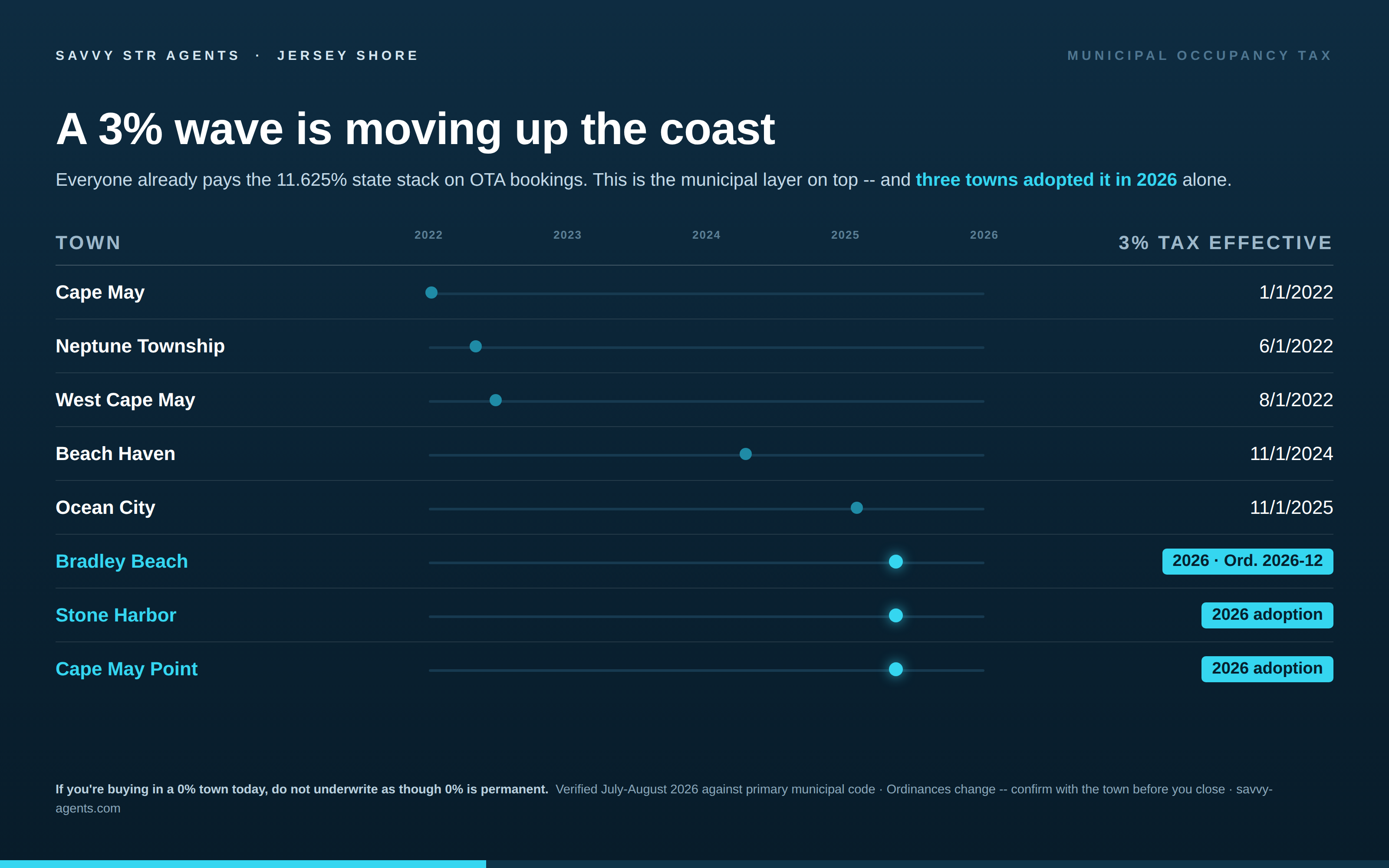
The map is also still moving. Bradley Beach, Stone Harbor, and Cape May Point all adopted a 3% municipal occupancy tax in 2026, following Ocean City in 2025 and Beach Haven in 2024. If I do not know a town’s answer, I test the deal with the extra 3% until I do.
What I verify before attorney review ends
- The minimum stay, and how the code defines a “day” or a “night”
- Whether the address, property type, and ownership structure qualify
- What registrations and inspections a new owner needs, how often they recur, and whether anyone has to be on site
- Which state and municipal taxes apply to the booking channel you actually intend to use
Get those in writing. If someone hands you a clean answer for every town on the coast, ask which primary source it came from.
Then I underwrite the house using Savvy’s short-term rental analysis guide and run the full Jersey Shore return, not just cash flow.
The fragmentation is annoying. It is also a moat. Many buyers will not read 26 ordinances or chase down what is missing online. I will. The useful answer is not which town is “best,” but which town fits what you are trying to build.
Have a town or address in mind? Book a call with me and I will show you what my file says about it. Earlier in the process? Start with the Jersey Shore Buyer Guide.
Verified July and August 2026 against primary municipal code and New Jersey Division of Taxation guidance. Ordinances and tax rules change. Treat this as a screening tool, not a legal or tax opinion.

Written by Cody Zucker
Cody Zucker is a Jersey Shore native and CPA with a background in financial services, asset management and Fortune 100 companies, experience he now applies to short-term rental investing across the Jersey Shore. Cody owns and manages a growing portfolio of short-term rental properties throughout Monmouth County, with deep roots just south in Ocean County, where he grew up and still knows the market cold. His experience extends well beyond the Shore: Cody has invested and operated STR properties in markets across the country, giving him a comparative lens on what actually drives performance from one market to the next. He brings a numbers-first, systems-driven approach to every deal, shaped by his finance background and sharpened by years of hands-on ownership and operations. Whether you're buying your first vacation rental or scaling an existing portfolio, Cody combines deep financial expertise with real operating experience to help you make confident, well-underwritten investment decisions. When he's not working on short-term rentals, you'll find Cody spending time with his family, staying active, or strolling the boardwalk back home at the Shore.
View Profile